



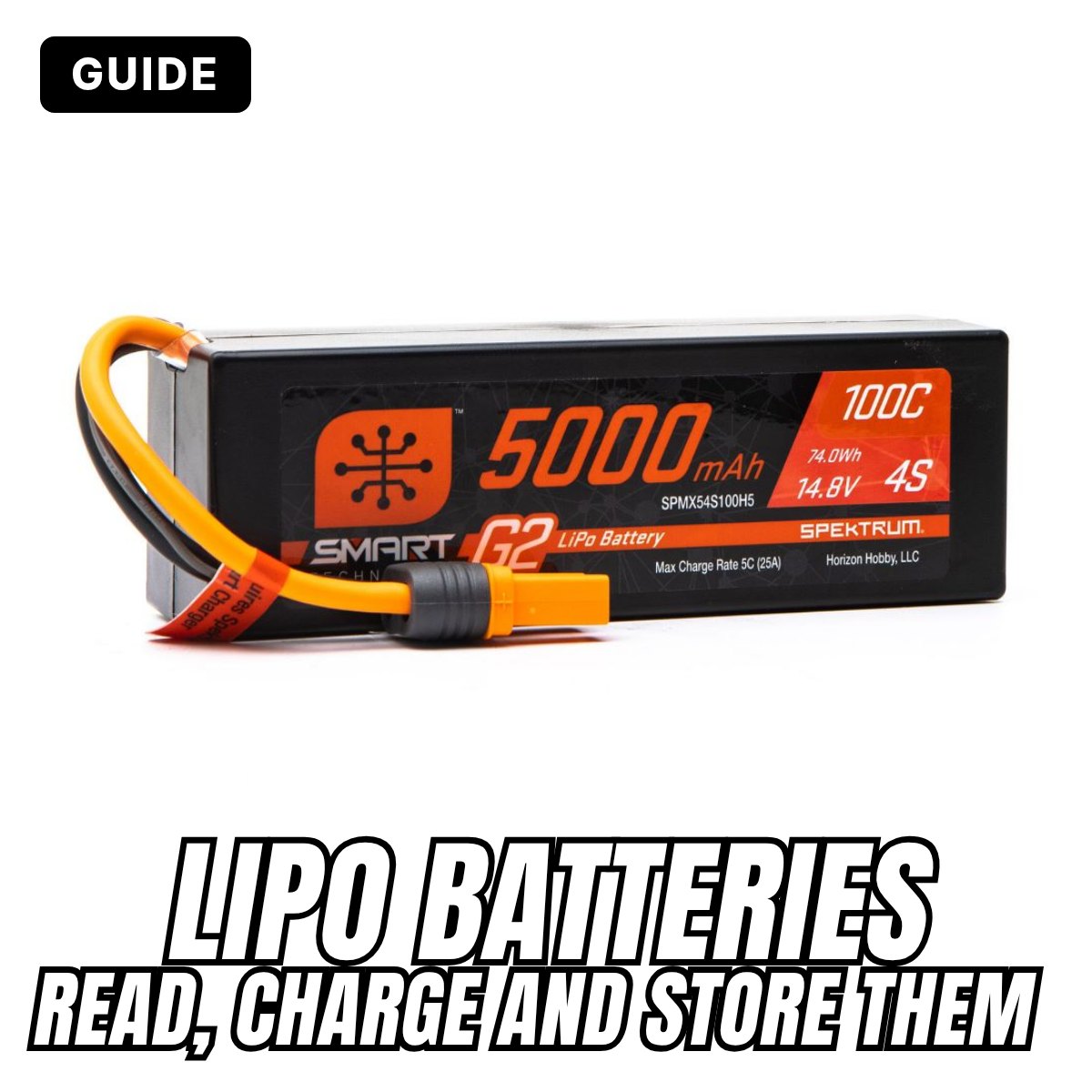
Almost every electric model today, cars, planes, helicopters, drones and boats, runs on LiPo batteries. They are light and deliver a lot of power, but they need a little care: they must be charged the right way, they must not be run too flat, and when you don't use them they must be put "to rest". You can read all sorts of things about them online. In this guide we line up what really matters: how to read the label, which voltages to respect, how to charge, store and transport them, and when it's time to dispose of them.
In short
- Each LiPo cell is used between 4.20 V (full) and about 3.5 V (empty). Below 3.0 V it gets damaged.
- Always charge with a LiPo charger with balancer, at 1C if you're not sure what to pick, and never unattended.
- If you won't use it within a day or two, bring it to storage voltage (about 3.80-3.85 V per cell) with the charger's Storage function.
- Use at most 80% of the capacity: land or stop before the battery is empty.
- A puffed, dented or punctured LiPo must never be charged or used again: discharge it and dispose of it.
What LiPo batteries are
LiPo stands for lithium polymer. A LiPo battery is made of one or more flat cells, sealed in a soft pouch and connected together. Compared with the old NiMH packs, for the same weight they store much more energy and release it much faster: that's what made today's fast, light electric models possible.
The flip side is that lithium doesn't forgive abuse. A LiPo that is overcharged, over-discharged, punctured in a crash or left in the heat gets damaged, puffs up and in the worst cases can catch fire. No need to panic: by following a few rules, millions of modellers have been using LiPos safely for years. Those rules are in this guide.
Car batteries are almost always hardcase, with the cells enclosed in a rigid plastic shell that protects them from impacts (it's mandatory in many races). Batteries for planes, helicopters and drones are usually softcase, with just the soft wrap: they weigh less, but need better protection.
How to read the label
Every LiPo label carries four numbers. They mean the same for every brand:

- S, the number of cells. "4S" means four cells connected in series. Each cell is 3.7 V nominal, so a 4S pack is 4 × 3.7 = 14.8 V. Sometimes you'll also see a P: "2S2P" means two pairs of cells in parallel, which doubles the capacity but not the voltage.
- V, the nominal voltage. It follows from the number of cells: 1S = 3.7 V, 2S = 7.4 V, 3S = 11.1 V, 4S = 14.8 V, 6S = 22.2 V. It's the "average" voltage in use: fully charged, the battery has more.
- mAh, the capacity. It tells you how much energy the battery holds, i.e. how long it lasts. A 5000 mAh (5 Ah) pack lasts twice as long as a 2500 mAh one in the same model, but it also weighs about twice as much.
- C, the discharge rate. It tells you how much current the battery can deliver. Multiply it by the capacity in Ah: a 5000 mAh 50C pack can in theory deliver 5 × 50 = 250 A. You often find two numbers, for example "50/100C": the first is the continuous rating, the second the burst for a few seconds.
Besides the thick lead with the power connector, every LiPo with two or more cells has a thin lead with a white plug: the balance plug. The charger uses it to measure and equalise the cells one by one. It always has one wire more than the cells: a 4S pack has a 5-wire plug.
Take the C rating with a pinch of salt. There's no common standard for measuring it and every brand calculates it its own way: one brand's 50C can be worth more than another's 80C. Treat it as a category indication and trust reputable brands. The real sign that a battery is "too small" for the model is that it comes back very hot after use.
The voltages you need to know
To use a LiPo well you have to think per cell. What applies to one cell applies to all of them: just multiply by the number of cells.

- 4.20 V: fully charged. This is the maximum: above it the cell gets damaged. The charger stops here by itself, if it's set to LiPo.
- 3.80-3.85 V: storage. The voltage at which the cell "rests" best. Use it when the battery sits for more than a day or two.
- 3.7 V: nominal voltage. The value printed on the label, halfway.
- About 3.5 V under load: end of use. This is where it's best to stop. At rest, after a few minutes, the same battery recovers to about 3.7-3.75 V: if that's what you read, you've used roughly 80% of the capacity, which is right.
- 3.0 V: the limit not to cross. Below this voltage the cell is permanently damaged: it loses capacity, puffs up and can become dangerous to recharge.
| Battery | Nominal | Full | Storage | Never below |
|---|---|---|---|---|
| 1S | 3.7 V | 4.20 V | 3.80-3.85 V | 3.0 V |
| 2S | 7.4 V | 8.40 V | 7.60-7.70 V | 6.0 V |
| 3S | 11.1 V | 12.60 V | 11.40-11.55 V | 9.0 V |
| 4S | 14.8 V | 16.80 V | 15.20-15.40 V | 12.0 V |
| 6S | 22.2 V | 25.20 V | 22.80-23.10 V | 18.0 V |
A small battery tester plugged into the balance lead shows the voltage of each cell in a moment: it's the easiest way to know what state a LiPo is in before charging or using it.
How to choose the right battery
- The model decides the cell count (S). Check the manual: it says how many cells the speed controller (ESC) and the motor accept. One extra cell gives more speed but can burn the ESC if it isn't designed for it.
- Capacity (mAh) is a compromise. More capacity means more minutes of use but more weight: in a plane or a drone too much weight takes away agility, in a car it changes the handling. Start with the one the manufacturer recommends.
- The C rating must be enough, with a margin. Divide the motor's maximum current by the capacity in Ah: if the motor draws 80 A with a 4000 mAh (4 Ah) pack, you need at least 80 ÷ 4 = 20C continuous. Get one with at least twice that margin.
- The connector must match the model, or it has to be changed (see the connectors below).
- The dimensions must fit the battery bay. Length, width and height are always on the product page: check them before ordering, especially for cars with a closed battery tray.
How to charge a LiPo safely
Charging is the most delicate moment in a LiPo's life. The rules are few and always apply:
- Only a LiPo charger, with the balancer. Always connect both the power lead and the balance plug, and choose balance charging (Balance charge). If you don't know which charger to get, see our LiPo chargers.
- Set the type and the cells correctly. Battery type LiPo (or LiHV, if it really is one), correct number of cells. Before starting, check that the charger "sees" the same number of cells as the label.
- Current: 1C if you're not sure. 1C means a current equal to the capacity: 5 A for a 5000 mAh pack, 2.2 A for a 2200 mAh one. That way an empty battery charges in about an hour. Some LiPos accept higher currents (it says so on the label), but at 1C they last longer.
- Never unattended. Stay nearby until charging is finished. Don't charge overnight while you sleep and don't leave home with a battery on charge.
- In a safe place. On a surface that doesn't burn (tiles, concrete, metal), away from curtains, wood, paper and fabric. Even better, inside a LiPo Safe bag or box.
- At room temperature. A battery that's just been used is warm: let it cool down before charging. And don't charge a frozen battery just back from the field in winter.
- If it gets hot or puffs up while charging, stop. A LiPo on charge can be slightly warm, never hot.
If a LiPo smokes or catches fire. Unplug the charger only if you can do it without getting close to the battery. Don't breathe the smoke. If you can do it safely, use pliers or a shovel to take it outdoors, away from everything, and cover it with sand. If the fire spreads, get out and call the fire brigade (112 in Europe). That's why it's always worth charging in a LiPo Safe bag or a metal box, with a bucket of sand nearby.
In use: don't run it too flat
A LiPo lasts a long time if you never run it to the bottom. The rule everybody uses is the 80% rule: use at most 80% of the capacity, i.e. about 4000 mAh of a 5000 mAh pack. At first, go by time: time your first runs, measure the resting voltage and how many mAh the charger puts back, then set a timer on your radio a little before that time.
- In cars and boats the ESC almost always has a low-battery protection (Low Voltage Cut-Off): when the voltage drops, it cuts the motor. Check in the ESC menu that it's enabled and set to LiPo.
- In planes, helicopters and drones that cut-off happens in flight and can bring the model down: better not to get there. Use the radio's timer, telemetry if you have it, or a small buzzer alarm plugged into the balance lead.
- In winter cold LiPos perform less: the voltage drops quickly under load. Keep them warm until shortly before use (in your pocket, in the car) and shorten your run times.
- After a crash check the battery: if it's dented, punctured or puffed, unplug it immediately, put it outdoors on a surface that doesn't burn and keep an eye on it for half an hour. Don't recharge it.
How to store it when you don't use it
A LiPo left at 100% ages much faster: it loses capacity, its internal resistance rises and over time it puffs up. One left empty for weeks gets damaged too, because the cells keep slowly self-discharging until they drop below the limit. The solution is storage voltage.
- Use the charger's Storage function. It brings each cell to 3.80-3.85 V by itself: it charges empty batteries and discharges full ones. Do it every time the battery will sit for more than a day or two.
- Charge fully only on the day you use it, or the evening before. If plans change, put it back to storage.
- In a cool, dry place, out of the sun: between 5 and 25 °C is ideal. Never leave it in the car in summer.
- In a LiPo Safe bag or box, away from things that burn. Not in a drawer full of paper, not on a wooden shelf.
- Disconnected from the model. Many ESCs draw a trickle of current even when switched off: within a few weeks they can drain the battery until it's ruined.
- For long breaks (the winter, for example) check the voltages once a month and put them back to storage if they've dropped.
How to transport it
- By car: at storage voltage if you can (charge only the ones you'll use), inside a LiPo Safe bag or box, never in the sun behind the windscreen.
- Protect the connectors: two contacts touching, or a metal object in the bag, cause a short circuit. Use caps or keep the batteries apart.
- By plane LiPos may only travel in hand luggage, never in the hold, with the contacts protected. What counts is the energy in Wh, which you get by multiplying the nominal voltage by the capacity in Ah: a 4S 5000 mAh pack is 14.8 × 5 = 74 Wh. Up to 100 Wh is usually allowed; between 100 and 160 Wh you need the airline's approval (two batteries at most); above 160 Wh they can't be carried. Before travelling, always check your airline's rules.
Power connectors
The connector must handle the current that flows through it. The ones you'll see most often:
| Connector | Indicative current | Where it's used |
|---|---|---|
| JST-PH, JST-RCY (BEC) | up to 2-5 A | Micro models, 1S and small 2S packs, receivers |
| XT30 | up to 30 A | Small drones, small planes |
| XT60 | up to 60 A | The most common: planes, FPV drones, 1/10 cars |
| Deans (T-plug) | up to 60 A | 1/10 cars, planes: found on many models |
| EC3 / IC3 | up to 60 A | Horizon and Spektrum models |
| XT90 | up to 90 A | 1/8 cars, large planes, boats |
| EC5 / IC5 | up to 120 A | 1/8 and 1/7 cars, 6S models |
The values are indicative: they also depend on the wire and the quality of the soldering. Spektrum IC3 and IC5 also fit EC3 and EC5. If the battery connector is different from the model's, the best solution is to change it by soldering on the right one; adapters add contacts and resistance and are better as a temporary fix. You'll find all the connectors in our shop.
If you change a connector, solder one wire at a time and insulate each joint straight away with heat-shrink tubing: the two battery wires must never touch, not even for an instant. Respect the colours: red positive, black negative.
When a LiPo is worn out, and how to dispose of it
A well-treated LiPo lasts a few hundred cycles. Sooner or later, though, it ages, and some signs tell you it has reached the end:
- It's puffed: the wrap is tight, the battery is "pillow-shaped" or no longer fits the bay. A puffed LiPo must not be charged or used again, even if it seems to work.
- It's dented, punctured or the wrap is cut, or the wires are stripped near the cells.
- The cells are unbalanced: after a balance charge one cell stays more than 0.05-0.1 V lower than the others, or it discharges much faster.
- It lasts much less and gets hotter than before. Many chargers measure each cell's internal resistance: if it rises a lot over the years, the battery is tired.
To dispose of it:
- Discharge it completely, slowly, with the charger's discharge function or with a battery discharger, outdoors or inside the LiPo Safe bag.
- Insulate the connectors with electrical tape.
- Take it to a battery collection point, for example your local recycling centre. Never throw it in household waste: in garbage trucks and waste plants lithium batteries cause fires.
LiHV, LiFePO4 and Li-ion: the LiPo's "cousins"
- LiHV (high-voltage LiPo): LiPos that charge up to 4.35 V per cell instead of 4.20 V and give a bit more punch. The label says "HV" or a nominal voltage of 3.8 V per cell (a 2S pack is 7.6 V). Charge them with the LiHV program; with the LiPo program they still charge, just a little less.
- LiFePO4 (or LiFe): 3.3 V nominal, fully charged at 3.6 V per cell. They give less power but are very robust: they're mainly used to power receivers and transmitters. Charge them only with the LiFe program.
- Li-ion (for example 18650 and 21700 cells): 3.6-3.7 V nominal, charged to 4.20 V, but they can be discharged lower. Lots of capacity and little power: they're used in transmitters and in models that need to stay in the air for a long time, not where you need punch.
Choosing the wrong charge program is dangerous: never charge a LiPo with the LiHV program, you'd take it to 4.35 V and ruin it.
Mistakes to avoid
- Charging without the balance plug connected. The cells drift apart and one can end up above 4.20 V.
- Leaving batteries at 100% for days. It's the quickest way to make them puff up.
- Flying or driving "until it stops". Hitting the ESC cut-off every time greatly shortens the battery's life.
- Charging a hot, puffed or dented battery. Let it cool down first; if it's puffed or damaged, it has to be disposed of.
- Leaving the battery connected to the model at the end of the day: it drains until it's ruined.
- Parallel charging several batteries without knowing how. Parallel charging boards are handy, but all batteries must have the same cell count and almost the same voltage before you connect them.
- Throwing it in the bin. LiPos must be discharged and taken to a collection point.
Frequently asked questions
Does a new LiPo need to be "broken in"?
A real break-in isn't necessary, but for the first two or three cycles it's worth using it gently, without pushing it to the limit, and charging it at 1C. Before the first charge, measure the cells: a new LiPo usually leaves the factory already at storage voltage, and all the cells should be almost the same.
How long does a LiPo battery last?
With correct use, a few hundred cycles, usually 200-300 or more. Heat, how deeply you discharge it and how long it sits at 100% matter a lot.
Can I leave it charged until the next day?
A day or two is not a problem. Beyond that, put it to storage: left at 4.20 V for weeks it ages much faster and ends up puffing.
The battery is a bit warm after use: is that normal?
Yes, warm is fine. If it's so hot you can't hold it in your hand, it's too small for the model (not enough capacity or C) or you're running it too long.
Can a LiPo that dropped below 3 V be recovered?
If it dropped only slightly and briefly, some chargers will recharge it at a very low current. But a cell that went very low may be damaged inside: check that it doesn't puff up or get warm while charging, and if in doubt, don't take the risk, dispose of it.
Can I use a LiPo with more cells to go faster?
Only if the ESC and the motor accept it: it's written in their manuals. One extra cell can burn the ESC, overheat the motor and break the drivetrain.
You'll find all our LiPo batteries for cars, planes, helicopters and drones, with cells, capacity, C rating, connector and dimensions on every product page. To charge them there are the LiPo chargers.
The voltages and rules in this guide apply to LiPos of every brand. Maximum charge and discharge currents, dimensions and connectors change from battery to battery: if in doubt, the label and the manufacturer's instructions are what counts.
Not sure which battery to get for your model? Come and see us at our shops in Passo Corese and Mogliano Veneto or write to us: we'll help you choose.
 See all our LiPo batteries