



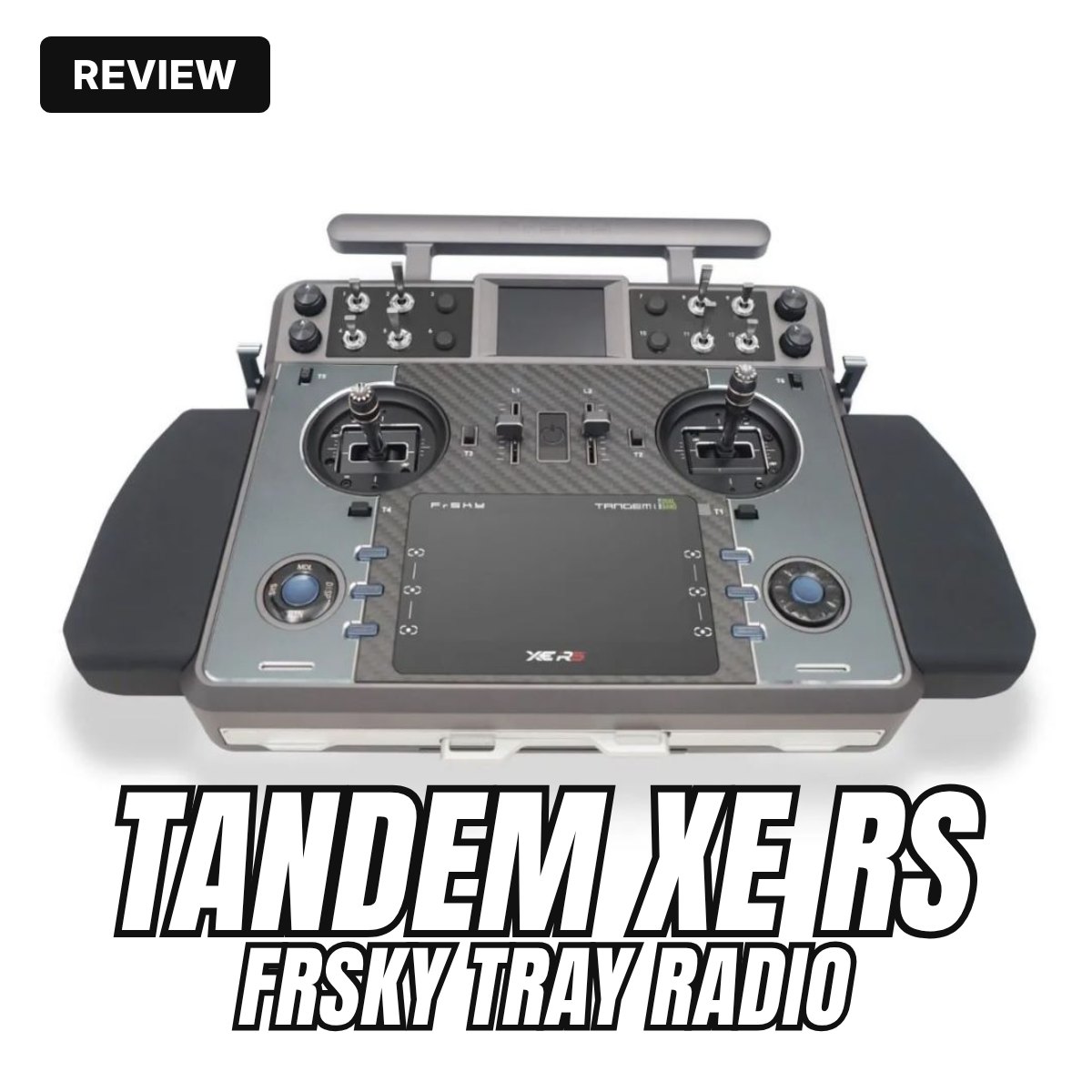
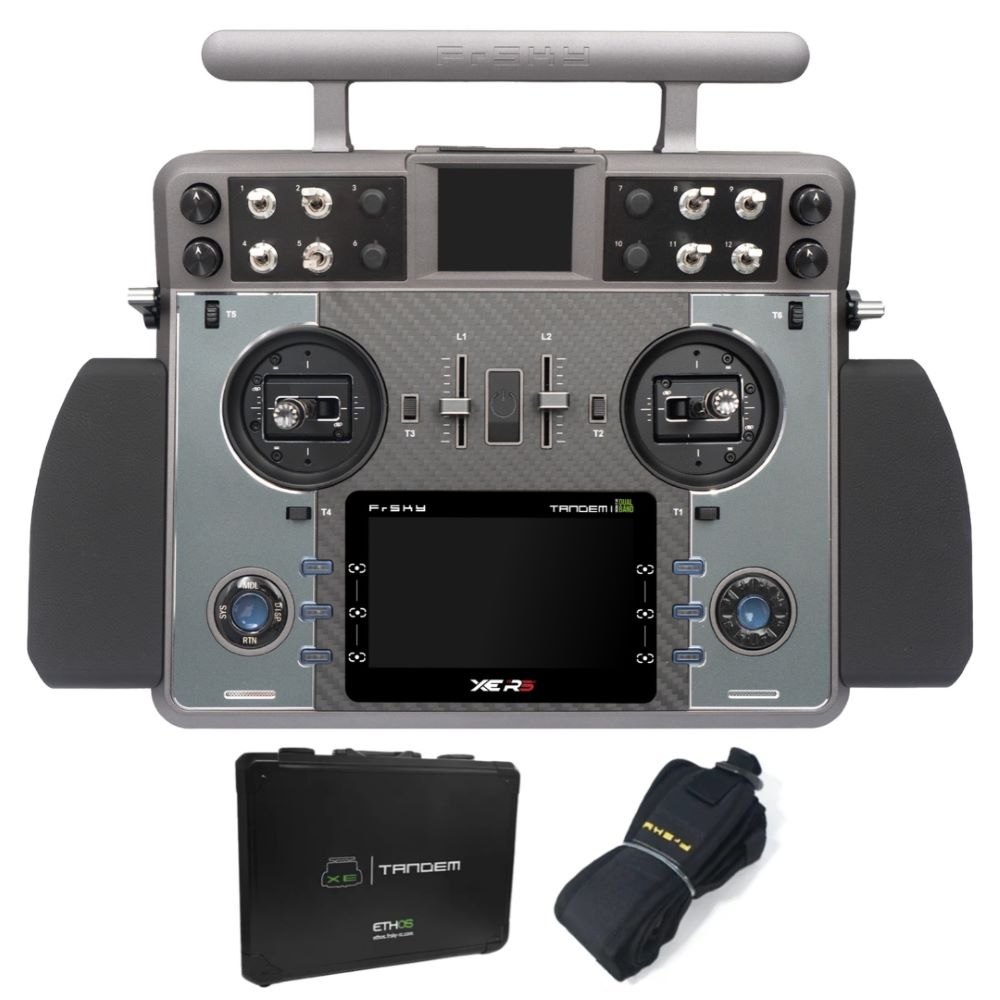
The FrSky Tandem XE RS is FrSky's new flagship for pilots who fly with a tray radio: the kind that rests on a neck strap, with your hands on the side rests and the sticks held between thumb and forefinger. Compared with the Tandem XE it replaces, it brings a new RF module, MC30R-XE gimbals adjustable from the front without opening the radio, and a top screen that's easier to read in sunlight. It has just arrived in our shop, so we put together FrSky's official data, the manual and the presentations by UK and US retailers to find out what's new and who it's for.
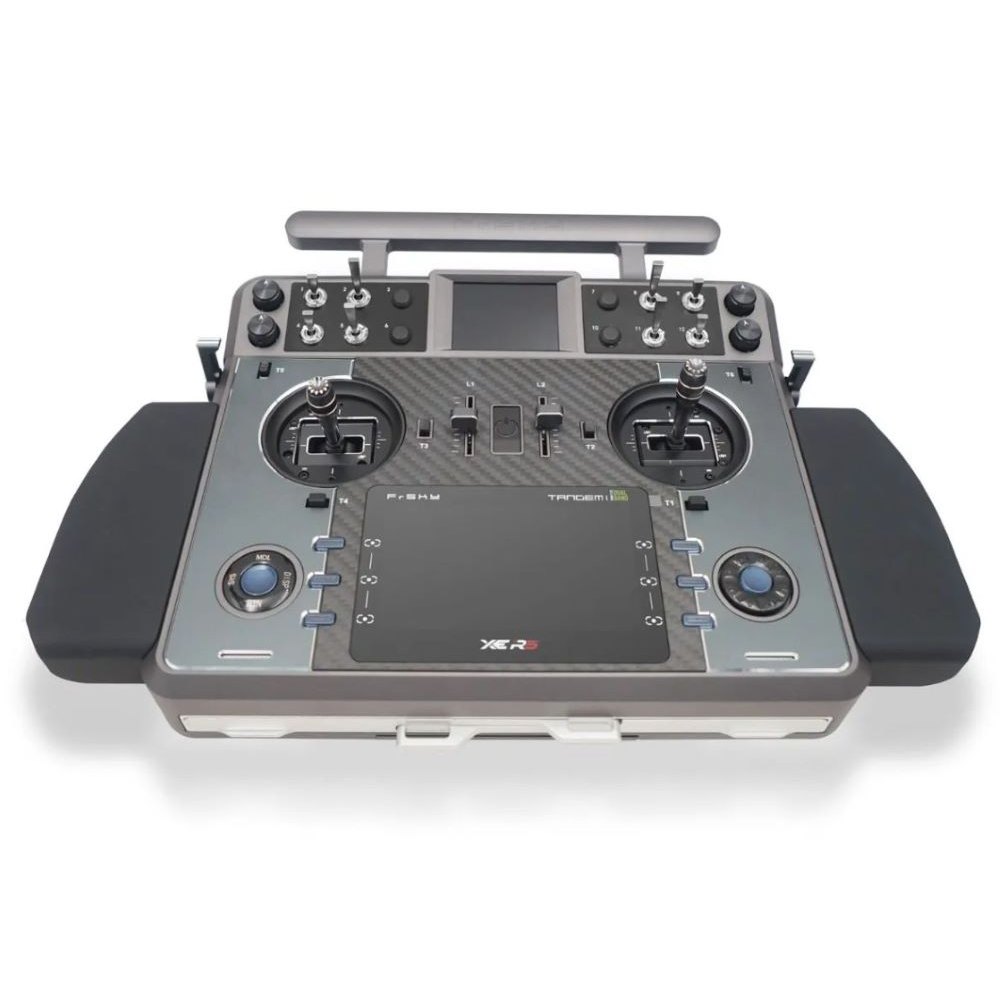
At a glance
- Tray radio running ETHOS, up to 24 channels.
- Dual band 2.4 GHz and 868 MHz in the same internal module (TD-ISRM Pro): TD, TW, ACCESS, ACCESS R9 and ACCST D16 modes.
- MC30R-XE gimbals, all CNC metal, Hall sensors, 10 ball bearings.
- Two colour screens: 4.3" touchscreen (800 × 480) and 2.4" top screen (320 × 240).
- 2S 4000 mAh battery included, charged through the USB-C port.
- Size and weight: 344.5 × 262 × 82 mm, 1530 g with the battery.
Why a tray radio
With a tray radio the weight is on the strap and your hands are supported: they don't hold the radio, they just fly. You hold the sticks with a pinch grip, between thumb and forefinger, which gives finer movements and less fatigue on long flights. That's why so many glider, aerobatic and helicopter pilots choose one. FrSky says it clearly: the XE RS series is designed for pilots who prefer tray-style radios and the pinch grip. Under the radio there's a foldable stand that keeps it upright on the table and doubles as the strap attachment.
What changes from the Tandem XE
Size, main screen and battery are the same as on the XE. There are four new things:
- TD-ISRM Pro RF module instead of the TD-ISRM, adding TW mode.
- MC30R-XE gimbals with every adjustment reachable from the front panel.
- 2.4" top screen that's easier to read in sunlight.
- Fixed knobs instead of retractable ones.
The trade-off is a few extra grams (1530 g versus 1492) and a higher typical current draw: 600 mA versus 460, according to FrSky. With the 4000 mAh battery that still means over six hours of use, based on the stated figures.

MC30R-XE gimbals: everything adjusts from the front
This is the upgrade you'll notice most. The MC30R-XE gimbals are all CNC-machined metal, with Hall sensors (contactless, so no wear) and 10 ball bearings. The front panel has dedicated holes: with a screwdriver you can adjust spring tension on both axes, damping, the ratchet for the throttle stick and stick travel, without removing the case. On the Tandem XE many of these adjustments meant opening the radio.
Y-axis travel adjusts from 45° to 60°. To limit the X axis to 45° you need a separate accessory, FrSky's travel limiter. According to FrSky, the gimbals' front panel can rotate by 8°, so you can angle the sticks the way that feels most natural. The gimbals also take FrSky's 3D and 5D extenders, which add axes and buttons at the stick tip.

Two screens
The main screen is a 4.3" colour touchscreen (800 × 480) for running ETHOS: models, mixes, telemetry, Lua scripts. Above it there's a second 2.4" colour screen, improved on the RS to be easier to read in sunlight. You choose what it shows in the settings or with a Lua script: for example, keep the model battery voltage, timers or telemetry always in view while the big screen shows something else. Besides the touchscreen there are two navigation controls: the SYS, MDL, DISP and RTN keys on the left, and the scroll wheel to move and confirm on the right.
Dual band: which receivers to use
The internal module works on 2.4 GHz and 868 MHz. 868 MHz is the European frequency; in non-EU listings you'll see 900 MHz. Each mode has its own receivers:
- TD: transmits on 2.4 GHz and 868 MHz at the same time, for FrSky TD series receivers. If one band suffers interference, the link carries on over the other.
- TW: new on the RS, two simultaneous 2.4 GHz links, for TW series receivers.
- ACCESS 2.4 GHz: for Archer Plus and Archer receivers.
- ACCESS R9: for R9 868 MHz long-range receivers.
- ACCST D16 (version 2): for older FrSky receivers updated to V2 firmware.
In practice almost all the FrSky receivers already in your models will work, and you can move to TD or TW one model at a time. On 2.4 GHz output power is fixed at 100 mW; on 868 MHz it's adjustable in several steps. There's also an external module bay in the Lite format, for other radio systems.
Switches, controls and customisation
- 8 switches as standard: 2- and 3-position, short and long levers, one momentary.
- Modular switch blocks: there are extra slots and the blocks can be swapped for other layouts.
- 6 trims, 4 knobs, 2 linear sliders and 2 CNC metal side levers.
- 6 programmable buttons beside the screen, for the functions you use most.
- Built-in 6-axis gyro, to control a function by tilting the radio.
- Haptic vibration and voice for alarms and telemetry alerts.
The side levers can be made self-centring with an optional accessory. FrSky gives the example of RC excavators: forward and back with a lever that returns to centre by itself. With 3D and 5D extenders on the gimbals, the XE RS also suits construction models and ground vehicles.
Battery, charging and connections
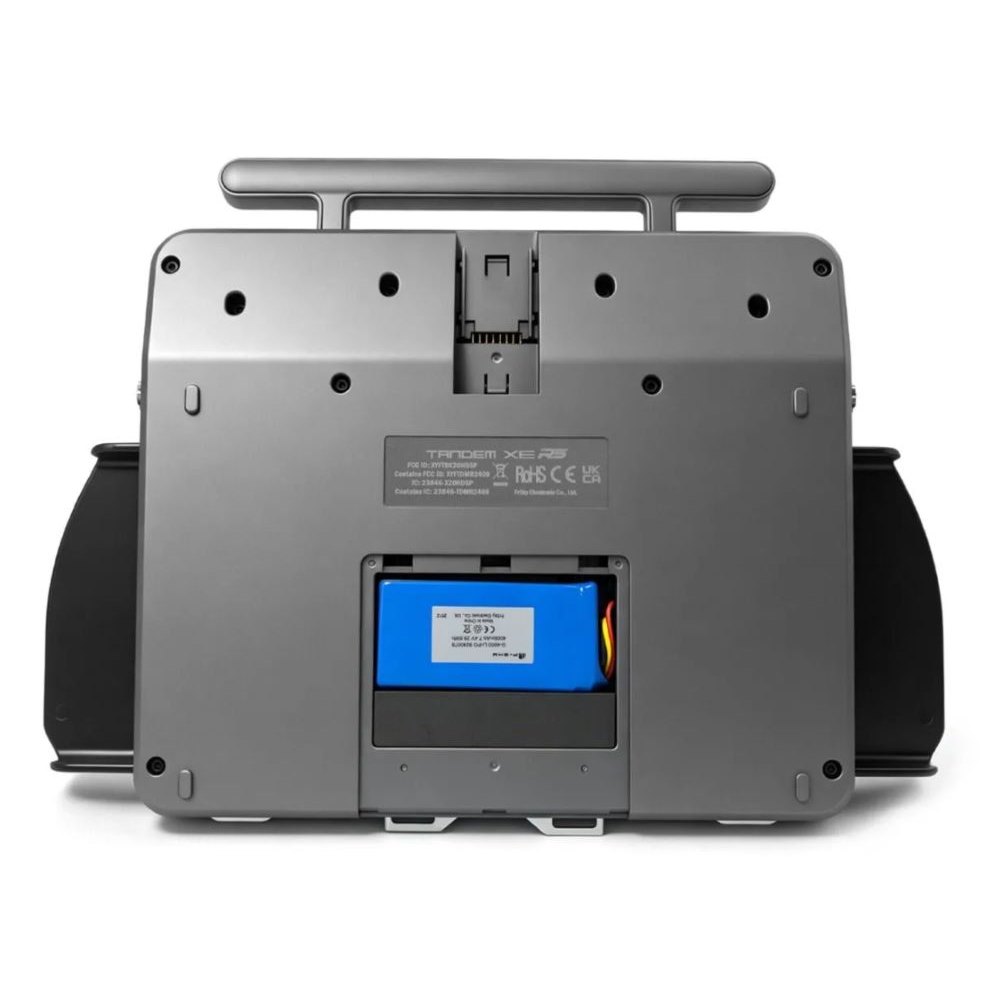
The included battery is a 2S 4000 mAh pack and it charges inside the radio through the USB-C port, with cell balancing. You need a 5 V USB power supply rated at least 2 A (FrSky recommends a certified 10-15 W one); the USB-C cable isn't in the box. The battery bay measures 86 × 61 × 20 mm, larger than needed: FrSky designed it to take a higher-capacity battery in the future.
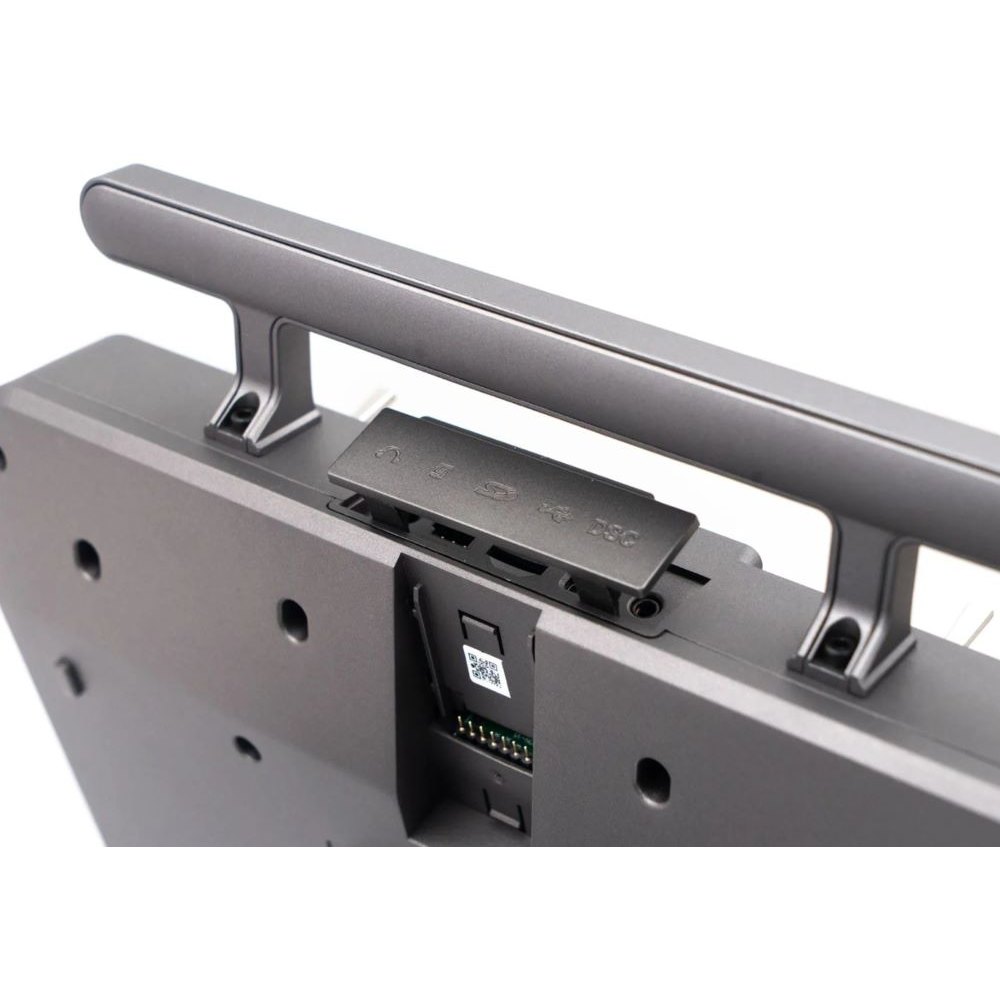
At the top, under a small cover, are the ports: USB-C for updates and charging, microSD (card not included), Smart Port for updating FrSky devices, the wired trainer port and the headphone jack. The trainer also works wirelessly, with the PARA system over Bluetooth. Updates and backups are done from a computer with ETHOS Suite.
What's in the box
- FrSky Tandem XE RS transmitter with built-in 2.4 GHz and 868 MHz RF modules.
- MC30R-XE gimbals.
- 2S 4000 mAh battery.
- Neck strap.
- Carrying case.
To buy separately: a USB-C cable and a USB power supply for charging, and a microSD card if you want more room for sounds and models. The radio can be set to mode 1, 2, 3 or 4.
The official video
Here's the Tandem XE RS in FrSky's presentation video. There's no commentary, but it shows the radio's details well.
Pros and cons
What we like
- Springs, damping, ratchet and travel adjust from the front, without opening the radio.
- Dual band with TD and TW, plus compatibility with almost every FrSky receiver.
- Two screens, with the top one easier to read in sunlight.
- Plenty of configurable controls, with swappable switch blocks.
- Quality build: carbon fibre, CNC metal, foldable stand.
Good to know
- At 1.5 kg it's a radio to use with the neck strap.
- The USB-C cable and power supply for charging aren't included, and neither is the microSD card.
- To use TD and TW you need TD and TW series receivers.
- The 45° X-axis travel limiter is a separate accessory.
- It's brand new: there are no independent tests with measurements yet.
The verdict
The Tandem XE RS takes a tray radio that was already complete and improves it where it matters for pilots who fly a lot: gimbals you can adjust in seconds, an extra RF link and a top screen you can read at the field in full sun. If you fly with a pinch grip and want an ETHOS radio you can configure down to the last detail, it's currently FrSky's most complete tray radio. If you already own a Tandem XE and don't need TW or front-panel adjustments, the upgrade is less pressing.
Discover the Tandem XE RSAll aircraft radios
Any questions? Visit our stores in Passo Corese and Mogliano Veneto or write to us: we'll help you choose the right receivers for your models.