



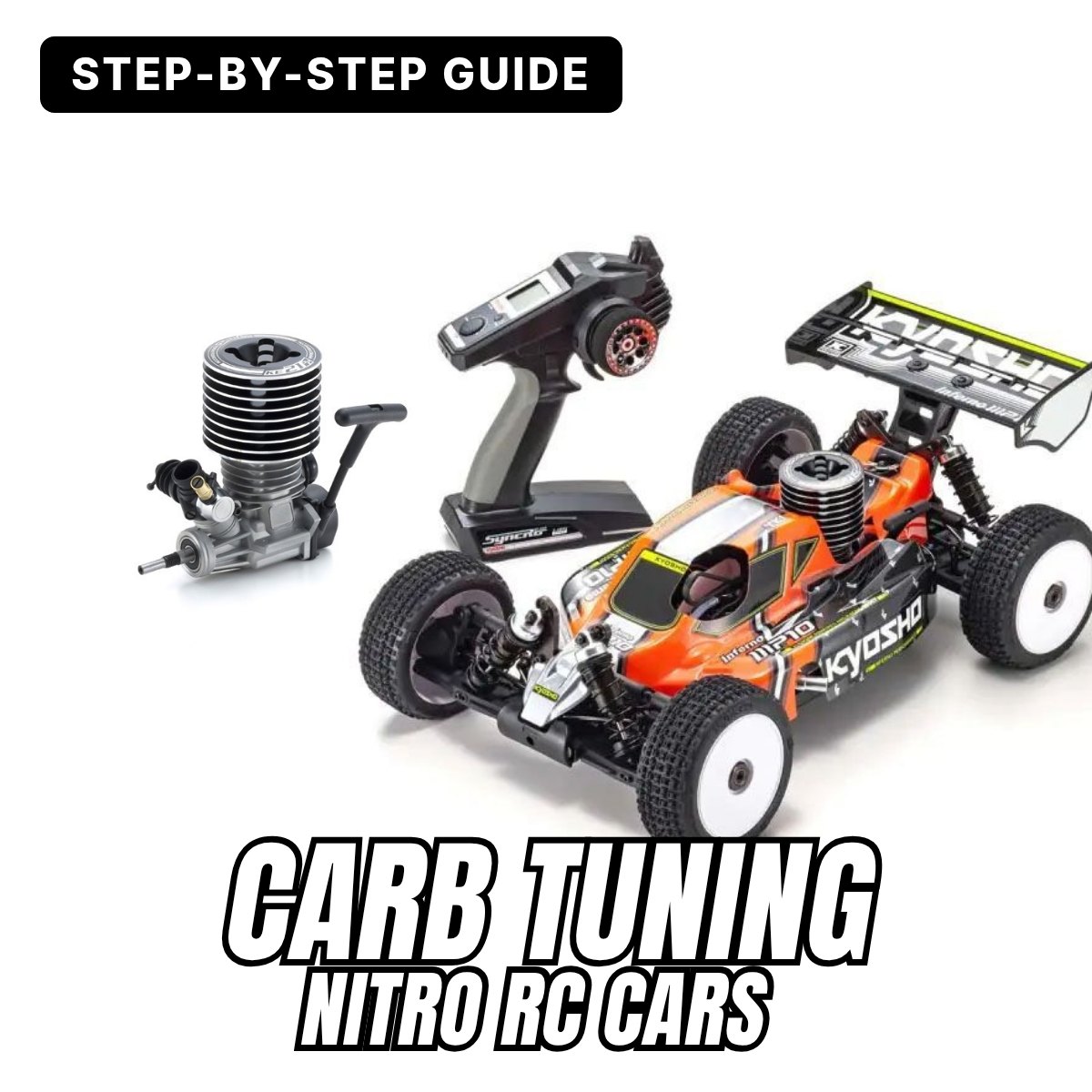
Carburation is the balance between the air and the fuel that go into the engine. A well-tuned engine starts straight away, holds a steady idle, pulls hard out of corners and, above all, lasts a long time. A badly tuned one runs hot, loses power and, in the worst cases, gets damaged. Don't worry: all you need is a screwdriver, a little patience and a few simple rules.
Before you start
- A run-in engine: if it's new, break it in first following the manufacturer's manual.
- A clean, oiled air filter: a dirty one throws off every test, a damaged one lets in dust that wears the engine out.
- A glow plug in good condition and fresh fuel, always with the same nitromethane percentage.
- Intact fuel lines, including the one from the exhaust to the tank: a crack lets air in and the engine seems lean even when it isn't.
- A warm engine: always tune after two or three minutes of running, never from cold.
The three adjustments

There are three screws on the carburettor and each one has its own job:
- High-speed needle (HSN): sets the mixture from half to full throttle. It's the one you'll adjust most often.
- Low-speed needle (LSN): sits at the end of the throttle barrel, on the opposite side from the arm. It sets the mixture at idle and when accelerating out of corners.
- Idle screw: it doesn't change the mixture, only how far the throttle stays open when you release the trigger, that is the idle speed.
For both needles the rule is always the same: turning clockwise closes the needle and the mixture gets leaner, turning anticlockwise opens it and the mixture gets richer. Turn a little at a time, 1/12 of a turn: like moving the hand of a clock by one hour. Before you touch anything, mark the needle head with a pen so you can always go back to where you started.

Step 1: the idle
With the engine warm and the model lifted off the ground, set the idle screw: the engine must run smoothly without stalling, but the wheels must stay still, because the clutch must not engage. If the wheels turn, back the screw out a little; if the engine dies as soon as you release the throttle, screw it in a little.
Careful: the cylinder head and the exhaust get very hot. Use a long screwdriver and keep your fingers away from the wheels and the drivetrain.
Step 2: the high-speed needle
Now head to the track. Do a few laps and watch the model on the straight at full throttle: there should be a light but always visible trail of smoke from the exhaust. If a thick cloud comes out and the engine gurgles, close the needle by 1/12 of a turn; if the smoke disappears, open it straight away. If you have an infrared thermometer, point it at the head near the glow plug: for most RC car engines, 95 to 120 °C is about right.

Once you're close, stop: the few metres you gain by leaning it out aren't worth a seized engine. Slightly rich is always better than slightly lean.
Step 3: the low-speed needle
For the low-speed needle there's a simple trick, the pinch test: with the engine warm and idling, pinch the fuel line going to the carburettor with your fingers and count how many seconds it takes to stop.

Then check on the track: out of corners the model should pick up cleanly, without a cloud of smoke (rich low end) and without hesitating or stalling (lean low end).
Step 4: check again
The adjustments affect each other: after setting the low-speed needle, the idle speed may change. Touch up the idle screw and, if needed, quickly check the high-speed needle again with a couple of laps at full throttle.
The most common mistakes
- Tuning a cold engine: smoke, sound and temperature are misleading.
- Turning half a turn at a time: you lose the sweet spot and risk ending up too lean.
- Chasing speed by leaning it out: the engine overheats, fades after a few laps and risks seizing.
- Forgetting the weather: temperature, humidity and altitude change the carburation. Check again every time you go out, always starting a little rich.
- Not knowing where to go back to: if you get lost, return the needles to the starting position given in your engine's manual and start again.
Need a hand? Come and see us at our stores in Passo Corese and Mogliano Veneto or write to us: we'll gladly help you tune your engine. And if you're looking for a new model, have a look at our nitro RC cars.