



The ESC (electronic speed controller) is the "brain" of an electric RC car's drive: it sits between battery and motor, reads the radio's trigger and decides how much power to send to the wheels, how hard to brake and when to reverse. With its BEC it also powers the receiver and the steering servo. In this guide we look at how to read the data of a car ESC, how to choose it for scale and battery, what sensored, drag brake and punch mean, and how to set it up, with the ESCs our customers choose most: Spektrum and Arrma Firma, LRP, SkyRC and XC-ESC.
In short
- The ESC must suit the motor type: brushed or brushless; and among brushless, sensored or sensorless.
- Check the cells and the motor limit (in turns or kV): these are the two figures you must never exceed.
- Choose the amps by scale, weight and battery, with a margin.
- Set the BEC to 6 V with a standard servo, to 7.4 V only with an HV servo.
- Before driving, do the neutral calibration and check the LiPo cutoff.
What an ESC does
When you pull the trigger, the radio sends the command to the receiver, the receiver passes it to the ESC and the ESC gives the motor the right current: a little to move off gently, all of it for full speed. When you push the trigger, the ESC brakes the motor and, if set up that way, goes into reverse.
A good car ESC also:
- powers the receiver and steering servo through the BEC;
- protects the LiPo battery, cutting power when the voltage drops too low;
- protects itself and the motor from overheating and excessive current;
- can be adjusted: brake, acceleration, reverse, and on many also timing.
How it is wired

- Battery: two thick wires, red positive and black negative. Reversing them destroys the ESC: use plugs that fit only one way.
- Motor: two wires for brushed motors, three (A, B, C) for brushless. With brushless, A goes to A, B to B, C to C.
- Sensor cable: only with sensored brushless motors, a flat lead between motor and ESC.
- Receiver: the three-wire lead goes into the throttle channel, which on pistol radios is almost always channel 2. Steering goes in channel 1.
- Switch and, on bigger ESCs, a cooling fan.
Brushed or brushless motor
The first thing to know is which motor you have, because the ESC must be made for it:
- Brushed motors: simple and cheap, found on many ready-to-run models, small cars and many crawlers. They need a brushed ESC, with two wires to the motor, like the LRP AI Runner Reverse.
- Brushless motors: more powerful, more efficient, almost maintenance-free. They need a brushless ESC, with three wires to the motor.
A brushed ESC will not run a brushless motor, and vice versa (except the few ESCs with both modes). The differences between the two motors are explained in the guide to brushed and brushless motors.
The motor limit
Every ESC has a limit on the motor it can drive. For brushed and racing motors it is given in turns (T): fewer turns means a faster, "hungrier" motor. If an ESC says "12T limit", motors of 12 turns and up are fine (13T, 17.5T...), a 10T is not. For off-road brushless motors the limit is often given in kV (rpm per volt): motors with the same or a lower kV are fine. The limit usually changes with the battery: with more cells it is tighter.
Sensored or sensorless
Brushless car motors come in two kinds:
- Sensorless: the ESC works out the rotor position from how the motor turns. They are tough, cheap and cope with water and mud: the normal choice for off-road 4x4s and bashing. The weak point is very low speed: starting from a standstill under heavy load, the motor can stutter a little (cogging).
- Sensored: sensors inside the motor tell the ESC exactly where the rotor is, through the sensor cable. Starts are smooth and precise, and control is linear even at walking pace: just what you need on the track and in crawlers.
A sensored ESC also works with a sensorless motor (in sensorless mode); a sensorless-only ESC ignores the sensors of a sensored motor, which still runs. Many modern ESCs also have a hybrid mode: sensored at low speed, sensorless at high speed.
How to read the data

- Continuous current (60 A, 100 A, 160 A...): what it handles for a whole battery. The burst figure, when given, matters little.
- LiPo cells (2S, 2-3S, 3-6S...): the minimum and maximum battery. What "S" means is in the guide to LiPo batteries.
- Motor limit, in turns or kV, often different for each cell count.
- BEC: voltage (6 V, 7.4 V, sometimes adjustable) and current.
- Motor type: brushed, sensorless brushless or sensored brushless.
- Reverse, waterproofing and, on the more advanced ESCs, telemetry or Bluetooth.
Which ESC for which car
Indicative values: your model's motor, weight and battery, and the car manufacturer's advice, have the final say.
| Model | Battery | Typical ESC |
|---|---|---|
| 1/10 crawler | 2-3S | 40-60 A brushed or sensored brushless, direct reverse, strong drag brake, 6-7.4 V BEC |
| 1/10 stock racing (13.5T, 17.5T, 21.5T) | 2S | 50-80 A sensored, with a zero-timing mode for racing |
| 1/10 modified racing | 2S | 120-160 A sensored |
| 1/10 2WD and 4x4 off-road | 2-3S | 80-120 A sensorless or sensored, waterproof |
| 1/8 buggies, truggies and monsters | 4-6S | 150-160 A, waterproof, with fan |
| 1/7, 1/6 and 1/5 | 6-8S | 160-200 A and more |
The ESCs we sell most
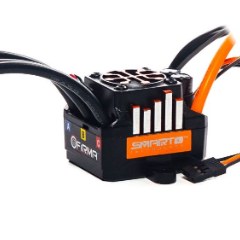
- Spektrum and Arrma Firma: waterproof, with Smart telemetry sending rpm, voltage and temperature to Spektrum radios. The Firma 100A for 1/10 cars on 2-3S, the Firma 150A and 160A for 1/8 cars up to 6 and 8 cells. They are the same ones fitted to Arrma models.
- LRP: from the brushed AI Runner Reverse, which sets itself up to the radio, to the sensored brushless Spin.
- SkyRC: TS50, TS120 and Toro, sensored, widely used on the track. The TS50 has no adjustable timing, which is why it is allowed in stock classes.
- XC-ESC: IP67 waterproof; with built-in Bluetooth they are set up from a smartphone and log rpm, voltage, current and temperature. C10 and E10 for 1/10, E8 for 1/8, E6 for 1/6.
The BEC: what powers the steering
The BEC is the regulator inside the ESC that powers the receiver and steering servo, lowering the battery voltage to 6 or 7.4 V. Two things to check:
- Voltage: on many ESCs you can choose it. With a standard servo (up to 6 V) use 6 V; 7.4 V only with an HV servo, which is stronger and faster at that voltage. A standard servo at 7.4 V gets damaged.
- Current: a strong servo steering a heavy car, perhaps with the wheels standing still on tarmac, can ask for many amps. If the BEC cannot cope, the voltage collapses and the receiver switches off for an instant: the steering "drops out" and the car goes straight on. It happens mostly with 1/8 cars and crawlers.
If the ESC's BEC is not enough, the solution is a more powerful external voltage regulator, connected directly to the battery. Everything about standard and HV servos is in the guide to RC servos.
Settings

- Driving mode: forward/brake for racing, forward/brake/reverse for general use, direct forward/reverse for crawlers. In the mode with brake and reverse, to back up you push the trigger (brake), return to neutral and push again.
- Drag brake: the brake the ESC applies by itself when you leave the trigger at neutral. Low on track and off-road, so the car "coasts"; high on crawlers, so they stay still on a slope.
- Brake force: how hard it brakes with the trigger fully pushed. Too much locks the wheels and spins the car.
- Punch (initial acceleration): how abrupt the start is. Low on slippery surfaces and with powerful 4x4s, which otherwise wheelie or spin; high on high-grip surfaces.
- Low-voltage cutoff: always on with LiPo, usually around 3.2-3.4 V per cell. Switch it off only with NiMH batteries.
- Timing, boost and turbo: electronic advance that makes the motor spin harder, but also hotter. Used on track in modified classes. In stock classes the rules require an ESC with no timing: the mode is often called blinky, because an LED flashes to show the officials it is active.
- BEC voltage and motor direction.
How to program it
- With the ESC's SET button: you scroll the items counting LED flashes or beeps. It works anywhere, but you must follow the table in the manual.
- With a program card: much easier. Each brand has its own: you will find them among the program cards.
- With a smartphone, on ESCs with Bluetooth like the XC-ESC, or from the radio, like the Spektrum Firma Smart with Spektrum radios.
Neutral calibration
Calibration teaches the ESC where your radio's neutral, full forward and full brake are. Without it the car may creep at neutral, not reach full speed or not reverse. Do it with a new ESC, when you change radio, and after changing the throttle trim or travel.
- Lift the car, with the wheels touching nothing.
- On the radio set the throttle trim to zero and the throttle travel to 100%; switch off any functions such as ABS.
- Switch on the radio, then hold the ESC's SET button and switch the ESC on.
- With the trigger at neutral press SET: one flash or beep.
- With the trigger fully pulled press SET: two flashes or beeps.
- With the trigger fully pushed press SET: three flashes or beeps. Done.
This is the most common sequence, but buttons and signals vary from brand to brand, and some ESCs (like the LRP AI Runner) calibrate themselves at power-up: follow the manual.
Temperature and gearing
An ESC and motor that get too hot are a sign that the car is working beyond its limits. As a rule, after a battery the motor should not go above 70-80 °C: if you can only keep a finger on it for a moment, it is too hot.
The most common cause is gearing that is too tall: pinion too big or spur too small. The fix is a pinion with a few teeth fewer. Other causes: a motor too fast (kV too high) for the car's weight, larger than normal tyres, too much timing, a stopped or dirty fan.
Almost all ESCs have thermal protection: when they get too hot they reduce or cut power, then restart once cooled down. If it happens often, the ESC is not faulty: something in the gearing or the driving needs to change.
Installing it properly
- Air. Mount the ESC where air flows, with the fan free and clean. A spare fan costs little and saves the ESC.
- Water. "Waterproof" means it copes with splashes, puddles and wet grass. It does not mean you can drive underwater. After running in the wet, dry everything, motor bearings included. Many racing ESCs are not waterproof: no rain.
- Short leads and the right plugs. Keep the battery leads short; with high currents you need suitable plugs, such as XT90, EC5 or IC5.
- Good solder joints, with a powerful soldering iron and heat-shrink tubing. You will find everything among our soldering tools.
- Mounting. With thick double-sided tape or in its holder, with the wires away from gears, belts and driveshafts.
Mistakes to avoid
- More cells than allowed, or a motor beyond the turns or kV limit.
- LiPo cutoff switched off: the battery goes too low and is damaged.
- BEC at 7.4 V with a standard servo.
- Reversed battery, even for an instant.
- Gearing too tall: motor and ESC boiling hot and thermal protection kicking in.
- A non-waterproof ESC in the wet.
- Skipped neutral calibration, with the car creeping on its own or braking weakly.
Frequently asked questions
The car won't reverse: is it broken?
Hardly ever. Check the driving mode: in forward/brake there is no reverse. In forward/brake/reverse you need the "double tap": push (brake), return to neutral, push again. If it still doesn't work, redo the neutral calibration.
The ESC flashes and the motor won't start: why?
Usually the ESC cannot find neutral and does not arm, for safety. Set the throttle trim to zero, check the lead is in the right channel and redo the calibration. Flashing in a different pattern can mean a flat battery or thermal protection: the flash codes are in the manual.
The motor stutters and shakes when I start from a standstill: why?
With sensorless motors a little hesitation when starting under load is normal. If it is severe, check gearing and punch. With a sensored motor, check that the sensor cable is properly connected and not damaged: a faulty sensor cable is the most common cause.
The car stops after a while and then starts again: why?
It is the thermal protection (ESC or motor too hot) or the low-voltage cutoff. In the first case, gear down and check the fan; in the second, it is time to change battery.
Can I use a 3S battery on a 2S ESC?
No: more cells than allowed burn the ESC. With a 3S you need an ESC that accepts it, and a motor suited to that voltage.
Can I use NiMH batteries?
Yes, almost all car ESCs accept them: set the battery type or switch off the LiPo cutoff, as the manual says. With LiPo, however, the cutoff must always stay on.
Is a car ESC fine in a plane or a boat?
No: planes have plane ESCs, with neutral at zero throttle and no reverse (see the guide to plane ESCs); boats need water-cooled ESCs.
Among our car ESCs you will find brushed and brushless ESCs for every scale, and among the ESC accessories sensor cables, plugs, fans and program cards. For the rest of the car there are the guides to LiPo batteries, RC servos and camber.
The values in this guide are indicative and apply to ESCs of all brands. Motor limits, calibration procedures and settings vary from model to model: when in doubt, the manufacturer's specifications and manual have the final say.
Not sure which ESC to pick for your car? Visit one of our stores in Passo Corese and Mogliano Veneto or write to us: we will help you choose.
 See all our car ESCs