



The ESC (electronic speed controller) is the electronics between the battery and the brushless motor: it reads the throttle command coming from the receiver and gives the motor the right amount of power. Almost always it does a second job too, less visible but vital: with its BEC it powers the receiver and the servos. In this guide we look at how to read the data of a plane ESC, how many amps you need, how to choose the BEC, how to set it up and how to install it, with the ESCs our customers choose most: Hobbywing, T-Motor and Spektrum.
In short
- Choose the amps with a 20-30% margin over the motor's maximum current with your prop and your battery.
- Check the cells: the battery must be within the ESC's range (for example 3-4S).
- Check the BEC: it must handle all your servos. With many or large servos you need a stronger BEC or a separate regulator.
- Before the first flight do the throttle calibration and set the brake and the low-voltage cutoff.
- On the bench always remove the prop. Connect the battery last, with the throttle at zero, and disconnect it first.
What an ESC does
A brushless motor cannot be connected straight to the battery: it has three wires, and to turn it needs a current that "jumps" from one wire to another thousands of times a second, always at the right moment. That is exactly what the ESC does. The more throttle you give, the faster and longer it feeds the motor, and the harder the motor turns.
On top of that, a good plane ESC:
- powers the receiver and servos through the BEC, so you need no separate battery;
- protects the battery: when the voltage drops too low it reduces or cuts power, so the LiPo is not damaged;
- protects itself from overheating and signal loss;
- brakes the prop at zero throttle when needed (folding props on gliders).
There are also ESCs for brushed motors: they have two wires to the motor instead of three and cannot be swapped with brushless ones. The differences between the two motor types are explained in the guide to brushed and brushless motors.
How it is wired

A plane ESC has three groups of wires:
- Two thick wires to the battery: red positive, black negative. Reversing them even for a moment destroys the ESC, which is why we use plugs that only fit one way, such as XT60, XT90 or EC5.
- Three wires to the motor, with bullet connectors. They go in any order: if the motor spins the wrong way, just swap any two of the three wires.
- A three-wire lead to the receiver, like a servo lead: it goes into the throttle channel. The signal wire carries the command; red and black bring the BEC's power to the receiver and servos.
How to read the data

On the product page of any ESC you will find more or less the same data:
- Continuous current (40 A, 60 A, 80 A...): the current the ESC handles for the whole flight. This is the number that matters when choosing.
- Burst current: what it handles only for a few seconds (usually about ten). It is a reserve, not a figure to choose by.
- LiPo cells (for example 2-4S or 3-6S): the smallest and the largest battery you can use. "HV" (high-voltage) ESCs go up to 12 or 14 cells. What "S" means is explained in the guide to LiPo batteries.
- BEC: voltage and current it can give to the receiver and servos, and whether it is linear or switching (more on this shortly). "OPTO" means there is no BEC.
- Brake and sometimes reverse (reverse thrust, to brake on landing or for 3D).
- Weight and size, which matter in a plane.
Amps: how big it must be

The rule is simple: the ESC must handle the motor's maximum current continuously, with a 20-30% margin.
The maximum current is not a fixed figure of the motor: it depends on the prop and the battery. The same motor with a bigger prop or one more cell draws much more. You can find it in three ways:
- in the motor manufacturer's tables, which give the current with various props and cell counts;
- in the model's specifications, if the plane's manufacturer recommends motor, prop and ESC;
- by measuring it with a wattmeter between battery and ESC, at full throttle for a few seconds, with the model held firmly. This is the safest method.
Then add the margin and take the next size up. Example: the motor draws 45 A, plus 25% is about 56 A: the right ESC is a 60 A.
Why the margin? Ratings assume a well-cooled ESC. Inside a fuselage, on a hot day, with a slightly bigger prop tried "just to see", the current goes up and the cooling goes down. An ESC that is only just big enough gets hot, loses efficiency and sooner or later burns out, often in flight. A bigger ESC does no harm: the motor only takes the current it needs.
Many motors also give their power in watts. To go from watts to amps, divide by the battery voltage: a 500 W motor on a 3S (11.1 V) draws about 45 A.
The BEC: what powers the receiver and servos
The BEC (Battery Eliminator Circuit) is a small regulator inside the ESC: it takes the high voltage of the flight battery and lowers it to 5-6 V for the receiver and servos. That way you need no separate battery. But if the BEC cannot cope, the voltage collapses and the receiver can switch off in flight (a brownout): one of the most dangerous failures, because you lose control of everything, not just the motor.
Linear or switching
- Linear BEC: simple and light, but it turns all the excess voltage into heat. Fine on small batteries (2-3S) and with a few small servos. More cells and more servos make it overheat until it shuts down.
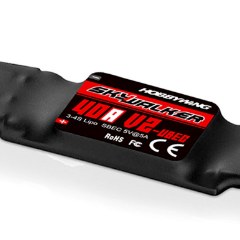
- Switching BEC (sometimes written SBEC or UBEC): much more efficient, handles more current and more cells. It is what you find on ESCs from 40 A upwards, for example on the Hobbywing SkyWalker V2 and Platinum, the T-Motor AT and the Spektrum Avian.
- OPTO: no BEC. The receiver and servos must be powered by a separate battery or an external voltage regulator. It is the usual choice on ESCs for 6 to 14 cell batteries, such as the Hobbywing Flyfun and SkyWalker HV OPTO.
How many servos it can handle
A servo at rest uses very little, but when it moves under load it can ask for 1-2 A, and a stalled standard servo even more. In flight the servos almost always move together. Indicative values:
| BEC | For example |
|---|---|
| 2-3 A | 3-4 micro or mini servos, small light models |
| 4-5 A | 4-5 mini or 4 standard servos, trainers and sport models up to about 1.4 m |
| 7-10 A | 6-8 digital standard servos, large aerobatic models and warbirds |
| more | better an OPTO ESC and a separate regulator or a receiver battery |
If you use HV servos, check the BEC voltage: many BECs give a fixed 5 V, and at 5 V an HV servo works but is weaker and slower. Some ESCs have an adjustable BEC, for example the Hobbywing Flyfun V5 and the Spektrum Avian, which go up to 8 V and beyond. Everything about servos and how to power them is in the guide to RC servos.
Which ESC for which plane
Indicative values: your model's motor and prop have the final say.
| Model | Battery | Typical ESC |
|---|---|---|
| Ultralight indoor and 3D (F3P) | 2S | 6-16 A, a few grams, like the T-Motor AM16A F3P |
| Park flyers, small gliders, first trainers | 2-3S | 15-30 A with BEC |
| Trainers and sport models, 1-1.4 m | 3-4S | 40-60 A with switching BEC |
| Aerobatic, 3D and warbirds up to 1.6 m | 4-6S | 60-100 A, strong BEC |
| Ducted fan jets (EDF) 70-90 mm | 6S | 80-130 A, strong BEC |
| Large models and 120 mm EDFs | 8-14S | 120-200 A HV, often OPTO |
To choose the right motor to go with it, see the guide to electric power systems for model planes.
The ranges we sell most
- Hobbywing SkyWalker V2: our customers' favourite. Affordable and reliable, from 15 A to 120 A, with a switching BEC in the medium and large sizes; there are also HV OPTO versions up to 14 cells.
- Hobbywing Flyfun V5: one step up, with an adjustable BEC and more settings.
- Hobbywing Platinum: for helicopters and demanding planes, with governor, a very strong adjustable BEC and full programming.
- T-Motor AT: light, from 20 to 115 A; the AM F3P are designed for ultralight indoor and 3D models.
- Spektrum Avian: thanks to Smart technology they send voltage, current, rpm and temperature to Spektrum radios through the throttle lead itself.
Settings
Almost all ESCs can be set up. The factory settings suit many models, but some should always be checked.
- Brake: on with folding props (gliders and motor gliders), so the prop stops and folds. Off with fixed props, which spin freely at zero throttle. Some ESCs, such as the Hobbywing SkyWalker V2, also offer reverse thrust on a separate channel, to brake on landing.
- Battery type and cells: LiPo or NiMH; the cell count is usually detected at power-up and announced with beeps.
- Low-voltage cutoff: the voltage below which the ESC cuts power. Usually set between 3.0 and 3.4 V per cell, sometimes as "low, medium, high".
- Cutoff type: soft (gradual power reduction) or hard (motor stop). In a plane soft is better: you feel the motor fade and have time to land. When it happens, land straight away.
- Timing: how early the ESC feeds the motor. The factory value (usually medium) suits almost all outrunner motors. Raise it only if the motor manufacturer recommends it: too much timing heats motor and ESC.
- Start mode: normal for planes; soft or very soft for helicopters and geared motors, to spare the gears.
The low-voltage cutoff is a lifesaver, not a way to time your flight. Use the radio's timer and land with about 20% left in the battery: the LiPo will last much longer. Everything else is in the guide to LiPo batteries.
How to program it
- With the throttle stick: you enter programming by holding full throttle at power-up; the ESC then plays a series of beeps for each item and you choose by moving the stick. It works on almost all ESCs, but you must follow the table in the manual.
- With a program card: much easier, everything is shown on a display or with LEDs. Each brand has its own: you will find them among the program cards.
- From the radio or an app: for example the Spektrum Avian Smart from compatible Spektrum radios.
After every change, disconnect and reconnect the battery: many ESCs only apply new settings at the next power-up.
Throttle calibration
Every radio has a slightly different throttle travel. Calibration teaches the ESC where zero throttle and full throttle are, so the motor starts straight away and really reaches full power. Do it with a new ESC, when you change radio or receiver, and after changing the throttle travel or trim.
The typical sequence, for almost all plane ESCs:
- Remove the prop.
- Switch on the radio and put the throttle stick at full.
- Connect the battery to the ESC: after a few seconds it plays a confirmation (usually two beeps).
- Within a few seconds bring the stick to minimum: the ESC plays the cell beeps and a long beep. Calibration done.
Timings and sounds vary from brand to brand: follow your ESC's manual. If you hold full throttle too long, many ESCs enter programming instead of calibration: in that case disconnect the battery and try again.
Safety. A brushless motor with a prop fitted can really hurt. On the bench, remove the prop. At the field, hold the model and stay behind the prop disc. Connect the battery with the throttle at zero and the radio already on, and disconnect the battery as soon as you land, before switching off the radio. And set the receiver's failsafe to minimum throttle: if you lose the signal, the motor stops.
Installing it properly
- Cooling. The ESC must sit where air flows, never wrapped in foam or shut in a bay with no vents. In a closed fuselage an air inlet at the front and an outlet at the back are enough.
- Short battery leads. If you need longer wires, extend the ones to the motor, not the ones to the battery. Long battery leads cause voltage spikes that over time damage the ESC's capacitors. If you really cannot avoid it, add capacitors close to the ESC, as the manufacturer advises.
- Plugs rated for the current. XT60 up to about 60 A, XT90 or EC5 above that. With 6 cells and more, an anti-spark plug (like the XT90-S) avoids the spark when you connect the battery.
- Good solder joints, with a powerful enough soldering iron and heat-shrink tubing on every joint. You will find everything among our soldering tools.
- Mounting. With Velcro or cable ties, away from the receiver and its antennas, with no wires touching moving parts.
- Twin-motor models. With two ESCs with BEC on the same receiver, you usually remove the red wire from one of the two leads, so the two BECs do not work against each other. Check what the manual says.
Helicopters and drones
Helicopter ESCs are similar to plane ones, with two extras: the governor, which keeps the rotor speed constant whatever the load, and the soft start, which brings the rotor up to speed over many seconds without jerks. The Hobbywing Platinum are made for this.
Racing drones and multirotors use dedicated ESCs instead, often four-in-one on a single board, driven by the flight controller with digital protocols. If you are interested, there is the guide to flight controllers.
Mistakes to avoid
- ESC chosen without a margin, or by its burst current instead of the continuous one.
- More cells than allowed. The ESC burns out at once, sometimes at the very first power-up.
- BEC too weak for the servos, especially with digital or large standard servos: the receiver switches off in flight.
- ESC with no airflow, shut in the fuselage or wrapped in foam.
- Extended battery leads instead of motor leads.
- Brake on with a fixed prop, or off with a folding prop.
- Ground tests with the prop fitted and the model not held.
- No failsafe set: if the receiver loses the signal the motor may keep running.
Frequently asked questions
I connect the battery, the ESC beeps but the motor won't start: why?
Almost always the ESC does not "see" zero throttle and does not arm, for safety. Check that the stick is fully down and the throttle trim centred or low, then redo the throttle calibration. On some radios, for example many Futaba, the throttle channel must be reversed (REV) for ESCs that require it: the ESC manual says so.
What do the beeps at power-up mean?
Usually a first tune says the ESC is on, then as many beeps as the cells detected, then a long beep when it is ready. If the cell beeps do not match your battery, check that it is charged. The exact meaning is in the manual.
The motor spins the wrong way: what do I do?
Swap any two of the three wires between ESC and motor. Some ESCs also let you reverse the direction in programming.
Can I use a bigger ESC than needed?
Yes, with no problem for the motor: it only takes the current it needs. The only drawback is a little extra weight and price.
In flight the motor fades or stops: why?
The most common causes: the battery has reached the cutoff (land straight away), the ESC has overheated and is protecting itself (it needs more air or a bigger ESC), or the battery cannot deliver the current and the voltage collapses under load. If the servos also move jerkily, suspect the BEC.
Can I use a car ESC in a plane?
Better not: a car ESC has neutral at mid-travel, and reverse and brake designed for another use. For planes there are plane ESCs, which cost the same and weigh less. For cars there is the guide to car ESCs.
Do I need an ESC with telemetry?
It is not essential, but it is handy: you see voltage, current and temperature on the radio in flight, and you can set an alarm when the battery gets low. The Spektrum Avian send it to Spektrum radios with no extra wires.
Among our plane ESCs you will find every size, from Hobbywing to T-Motor and Spektrum, and among the ESC accessories connectors, leads, heat-shrink, fans and program cards. For the rest of the power system there are the guides to LiPo batteries, RC servos and chargers.
The values in this guide are indicative and apply to ESCs of all brands. Calibration and programming procedures, thresholds and settings vary from model to model: when in doubt, the manufacturer's specifications and manual have the final say.
Not sure which ESC to pick for your plane? Visit one of our stores in Passo Corese and Mogliano Veneto or write to us: we will help you choose.
 See all our plane ESCs